By Maisie Sullivan
British Cooking History: From Mrs Beeton to Michelin Stars
How Britain went from household rulebooks and Sunday roasts to world-class restaurants, and what each cook can teach yours.
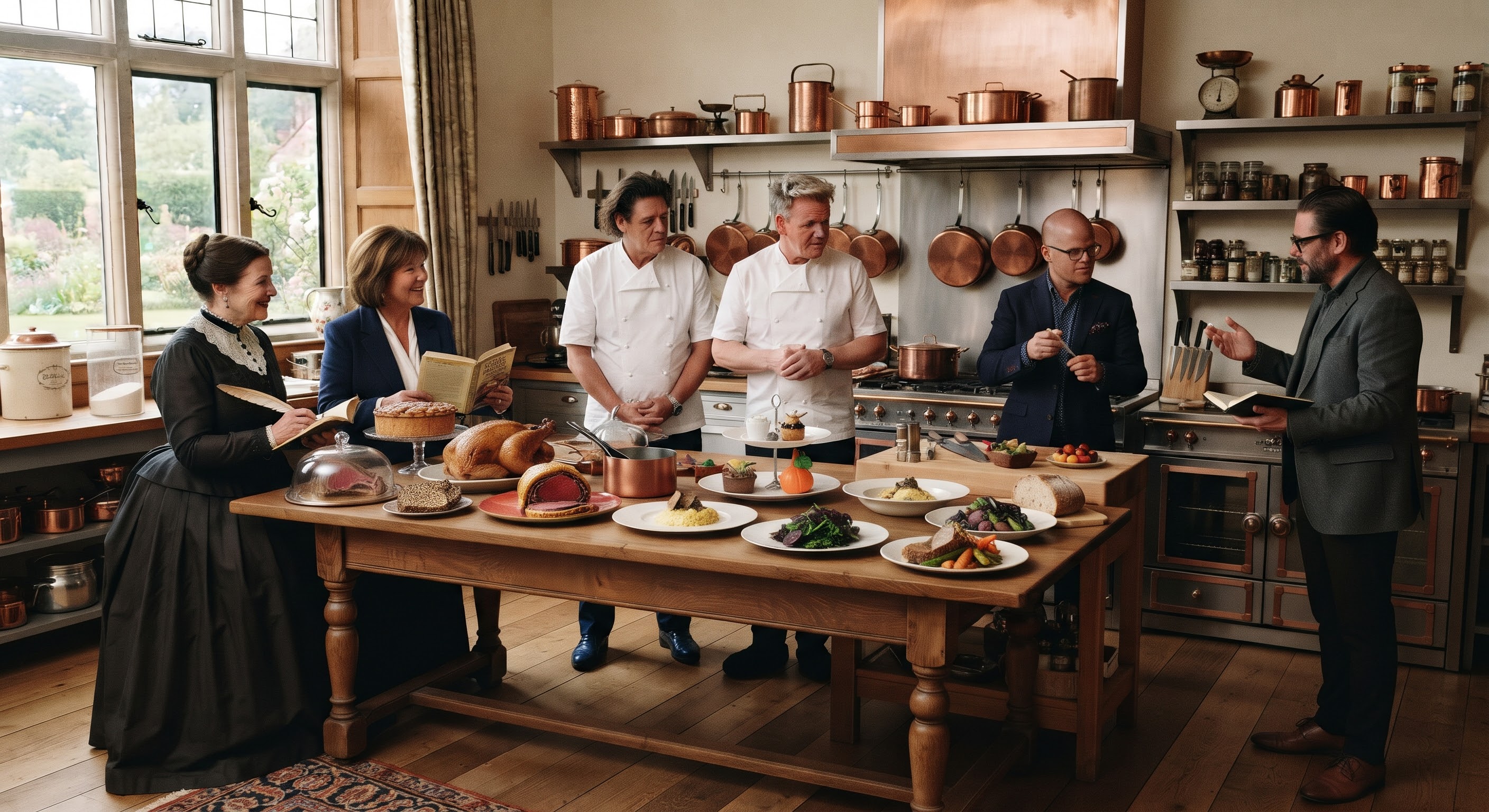
Last Sunday I had one eye on the roast potatoes and the other on a splattered, much-loved cookbook, and it struck me how many voices are in my kitchen. Some are in the books on the shelf. Some are in my head, shouting about seasoning. Together they tell the story of how Britain learned to cook, and it's a better one than the old jokes about boiled cabbage suggest.
Let's start with Mrs Beeton. Her Book of Household Management appeared in 1861, and it was far more than a recipe collection. It was a manual for running a home. What made it so useful was the layout: ingredients listed up front, a clear method, and an idea of timings. Many of the recipes were gathered from other writers and readers, so think of her as a brilliant editor as much as a cook. She died in 1865, aged only 28, yet her name stayed on kitchen shelves for generations. Her lesson is the one I still forget on busy evenings: read the whole recipe before you start.
Fast forward to Delia Smith, who taught a very different Britain. Her early book How to Cheat at Cooking came out in 1971, and her How to Cook series in the late 1990s went back to basics, showing viewers how to boil an egg, make an omelette and roast properly. Her recipes were tested until they worked, and people trusted them. The so-called Delia Effect, with shops running short of whatever she'd just cooked on television, shows how much. Beeton gave us the rules, but Delia gave us the confidence to follow them.
Then the temperature rose, and I mean that literally. Marco Pierre White opened Harveys in Wandsworth in 1987 and cooked classical French technique with real ferocity. His book White Heat (1990) made the professional kitchen look like a battlefield, and he won three Michelin stars before handing them back in 1999. What I love about his cooking is how stripped back it was: great ingredients, precise technique, nowhere to hide. At home, that translates to tasting as you go and seasoning in layers rather than all at the end.
One of the young cooks who trained under him at Harveys was Gordon Ramsay. His Chelsea restaurant, Restaurant Gordon Ramsay, opened in 1998 and earned three stars in 2001. Since then he has built a global business and become one of the most recognisable faces on television. You may find the shouting hard to watch, but the discipline underneath it is worth stealing. Keep your station tidy, prepare everything before you light the hob, and clear as you go. I'm never as organised as a brigade, but even a clean chopping board mid-recipe makes dinner calmer.
Heston Blumenthal came at things from another angle entirely. The Fat Duck opened in Bray in 1995 and went on to win three Michelin stars, with dishes like bacon-and-egg ice cream and snail porridge that made diners rethink what a plate could do. Yet he was also fascinated by why things work. His triple-cooked chips, simmered, dried and then fried twice, are one of the few restaurant ideas that really have crossed into home kitchens. His later restaurant, Dinner, even went back to historical British recipes, which brings us rather neatly full circle to the Victorian cookbook on my shelf.
The newest chapter belongs to cooks like Simon Rogan, whose restaurant L'Enclume in Cartmel, Cumbria, is supported by its own farm. Rather than flying in luxuries, he cooks what grows on his doorstep and lets the seasons set the menu. It's not so far from what many households did long before supermarkets, which is a lovely irony. Britain didn't lose its farming roots, it rediscovered them.
So how did we get from stereotype to melting pot? Partly through all of these cooks, but also through the people who watched, read and cooked along. Home cooks were never just the audience. We asked for clearer instructions, then better ingredients, then bolder flavours. Restaurants listened, and then the ideas flowed back into our kitchens.
Here's my practical bit for this weekend, a Sunday joint with a little of everyone in it. Take your beef out of the fridge an hour before cooking and season it generously (Marco). Read the method twice and weigh everything out first (Beeton, Ramsay). Roast it in a hot oven, 220°C (200°C fan/425°F) for the first 20 minutes, then turn it down to 180°C (160°C fan/350°F). Use a thermometer rather than guessing (Delia, Heston): take the joint out at about 50°C (122°F) for rare or 55°C (131°F) for medium. Let it rest for 20 to 30 minutes under foil, as the temperature will keep climbing. Finally, build the rest of the plate from what's in season near you (Rogan), such as roasted parsnips, cabbage or a bowl of buttery leeks.
If you find a version of any of these that really works for your household, save it to a RecipeFiler cookbook with your own notes. That's how recipes become family ones. Beeton would have approved, I think, and Delia would have asked if you'd tested it twice.