
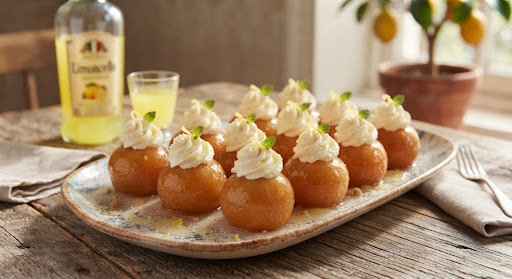
Traditional Limoncello Babà, GBBO inspired
by J_C • 2026
Why some badges are missing
- Not vegan: unsalted butter → try dairy-free butter
- Not gluten-free: strong white bread flour → try gluten-free plain flour
- Not dairy-free: unsalted butter → try dairy-free butter
- Not egg-free: large eggs → try ground flaxseed and water (1 tbsp ground flaxseed + 3 tbsp water per egg, rested 5 min)
- Not low-FODMAP: strong white bread flour → try gluten-free plain flour
- Not low-histamine: lemon zest
- Not low-GI / diabetic-friendly: strong white bread flour → try wholemeal flour
- Not kidney-friendly: fine sea salt → try salt-free herb seasoning (or lemon zest and black pepper)
Based on listed ingredients — always check labels for allergies.
Prep
30m
Cook
25m
Rest
150m
Serves
Rating
—
Total time · 55m
Ingredients
Kitchen HelpIngredients for Traditional Limoncello Babà, GBBO inspired
250 g strong white bread flour
20 g fresh yeast — or 7g / 1 sachet of fast-action dried yeast
15 g caster sugar — 1 tbsp
50 ml lukewarm water
4 eggs large eggs — room temperature (approx. 175g total)
5 g fine sea salt — 1 tsp
75 g unsalted butter — softened completely to room temperature (beurre pommade)
450 ml water
250 g caster sugar
1 pieces lemon zest — pared rind of 3 large, unwaxed lemons (pith removed)
200 ml Limoncello liqueur — chilled or room temperature
3 tbsp lemon marmalade or smooth apricot jam
1 tbsp extra Limoncello — to thin the glaze
250 ml double cream
1 tbsp icing sugar
1 lemon fresh lemon zest — a light grating for decoration
Tools
- · mixing bowl
- · stand mixer
- · dough hook
- · baking molds
- · saucepan
- · wire rack
- · brush
Instructions
How to make Traditional Limoncello Babà, GBBO inspired
- 1
Activate the yeast: In a small bowl, dissolve the fresh yeast and caster sugar into the lukewarm water. Leave it in a warm corner for 5 to until frothy.
- 2
Initial mix: Place the strong white flour and fine sea salt into the bowl of a stand mixer fitted with the dough hook. Pour in the yeast mixture and mix on a low speed to combine into a shaggy mass.
- 3
Incorporate the eggs: Beat your room-temperature eggs lightly in a jug. With the mixer running on low-medium speed, pour the eggs in gradually—about a quarter at a time—waiting until each addition is fully absorbed before adding the next.
- 4
Develop the gluten: Increase the mixer speed to medium-high and knead for 10 to . The dough will initially be extremely wet and cling to the bowl; do not add flour. As the gluten develops, it will wrap around the hook, turning glossy, elastic, and smooth.
- 5
Add the butter: Turn the mixer down to low and add the softened butter a tablespoon at a time, ensuring each piece is fully absorbed. Once incorporated, beat on medium for 3 to until luxuriously silky and stretchy.
- 6
First fermentation: Scrape the dough into a clean, lightly oiled bowl, cover with cling film, and leave to prove in a warm, draught-free spot for 1.5 to 2 hours until doubled in volume.
- 7
Prepare molds: Thoroughly brush 12 individual babà molds (or a standard savarin ring tin) with softened butter and dust lightly with flour or caster sugar, tapping out the excess.
- 8
Fill molds: Knock back the risen dough gently. Spoon or pipe it into the molds, filling them half to two-thirds full.
- 9
Second rise: Cover loosely with a damp tea towel and leave to prove for 45 to until the dough balloons up and crowns slightly over the rims.
- 10
Bake: Preheat your oven to 190°C / 180°C fan (Gas Mark 5). Bake for 20 to until a deep, rich amber-golden brown and hollow-sounding when tapped.
- 11
Cool: Rest in the molds for , then invert onto a wire rack to cool completely. (Tip: For optimal syrup absorption, let the baked babàs sit uncovered overnight to dry out slightly).
- 12
Infuse syrup: In a wide saucepan, combine the water, caster sugar, and pared lemon peel. Bring to a boil, stirring until the sugar dissolves, then simmer gently for .
- 13
Add liqueur: Remove from the heat completely and stir in the Limoncello. Keep the syrup warm (around 50°C–60°C).
- 14
Soak: Submerge the cooled babà cakes into the warm syrup for 20 to 30 seconds, turning them gently so they drink up the liquid to the core. Squeeze them very gently to remove excess liquid, then transfer to a wire rack over a tray.
- 15
Glaze: Gently warm the lemon marmalade with a tablespoon of Limoncello until liquefied. Brush the exterior of each soaked babà to give them a brilliant, glossy sheen.
- 16
Chantilly cream: Whip the chilled double cream with the icing sugar and a pinch of fresh lemon zest until soft-to-medium peaks form.
- 17
Serve: Slice the babàs open down the center or pipe a generous rosette of lemon Chantilly cream right into the middle. Serve immediately with an extra chilled shot of Limoncello on the side.
Nutrition per serving
serves 12AI estimate only — not medical advice. Figures are approximations based on standard ingredient data and may vary by brand, portion size and preparation. Always double-check if cooking for allergies, diabetes, or strict dietary needs.
Rate this recipe
Shared notes
Cook's annotations
No notes yet.
Family legacy
Audio reminiscence
A short voice memory — Mum reading the recipe out, a grandparent sharing the story behind it, a tip whispered while cooking. Up to ~60 seconds.
No audio memory yet.
Complete the table
Smart wine & side pairings
