Rustic Coburg Bread
by J_C • 2026
Why some badges are missing
- Not vegan: unsalted butter (softened) → try dairy-free butter
- Not gluten-free: strong white bread flour → try gluten-free plain flour
- Not dairy-free: unsalted butter (softened) → try dairy-free butter
- Not low-FODMAP: strong white bread flour → try gluten-free plain flour
- Not low-GI / diabetic-friendly: strong white bread flour → try wholemeal flour
- Not kidney-friendly: fine sea salt → try salt-free herb seasoning (or lemon zest and black pepper)
Based on listed ingredients — always check labels for allergies.
About this recipe
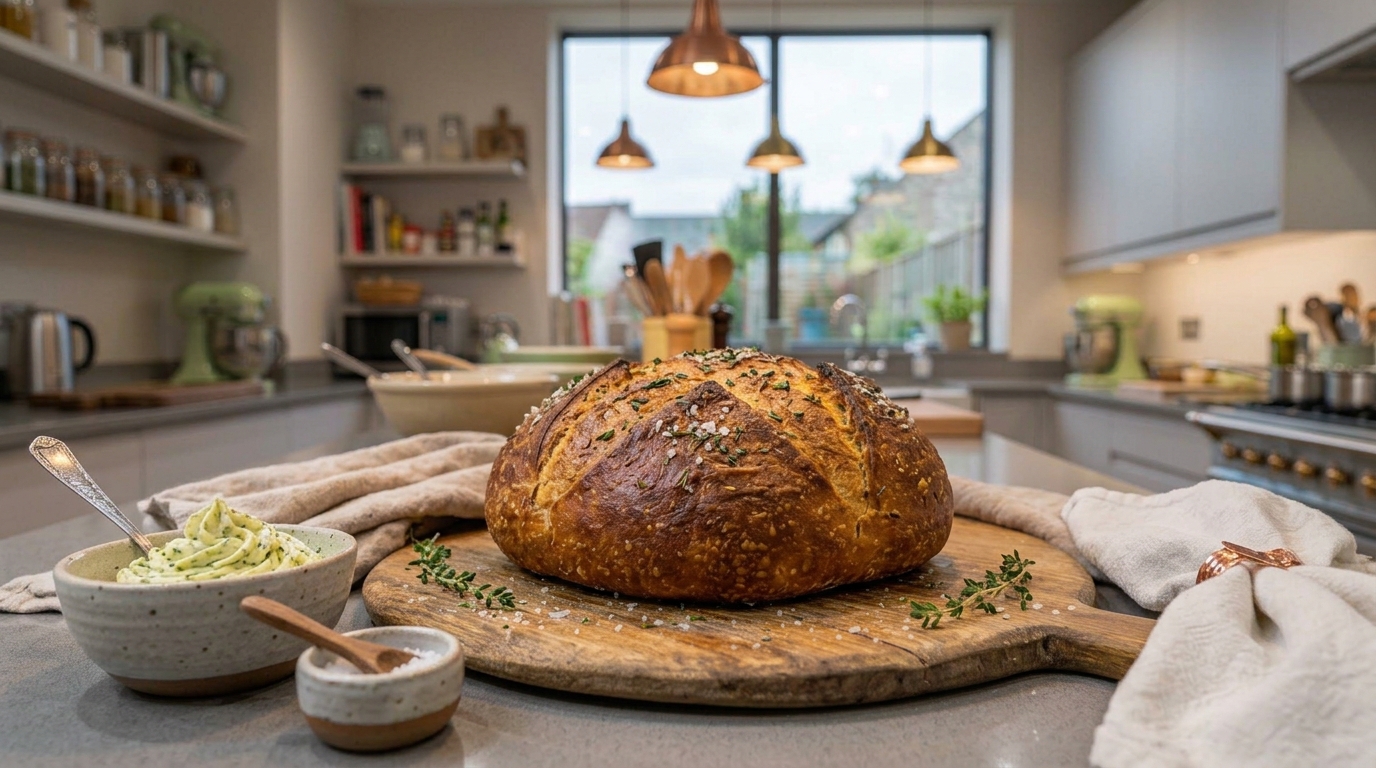
The traditional Rustic Coburg bread loaf is a classic British round loaf known for its tall, domed shape and deep, intersecting cross slashed into the top. Baked with strong bread flour, it develops a wonderfully crackly, golden-brown crust and a soft, fluffy crumb, making it an artisan centrepiece.
Prep
35m
Cook
40m
Rest
135m
Serves
Rating
—
Total time · 1h 15m
Ingredients
Kitchen HelpShopping list
500 g strong white bread flour — plus extra for dusting
7 g fast-action dried yeast — (1 sachet / 1.5 tsp)
5 g caster sugar — (1 tsp)
10 g fine sea salt — (2 tsp)
30 g unsalted butter (softened)
320 ml lukewarm water
Tools
- · large mixing bowl
- · spatula
- · clean work surface
- · baking tray
- · parchment paper
- · sharp knife or lame
- · roasting tin
- · wire rack
Instructions
Step by step
- 1
Combine dry ingredients: In a large mixing bowl, whisk together the 500g strong white bread flour, 7g fast-action yeast, and 5g caster sugar. Add the 10g fine sea salt to the opposite side of the bowl away from the yeast so they do not make direct contact.
- 2
Incorporate liquids: Pour in the 320ml lukewarm water and add the 30g softened unsalted butter. Mix with your hands or a spatula until a sticky, cohesive dough forms and no dry flour remains at the bottom of the bowl.
- 3
Knead: Turn the dough out onto a clean, un-floured or very lightly floured work surface. Knead vigorously for 10 to , stretching, pushing, and folding the dough over itself. You will feel it transform from sticky and rough to smooth, elastic, and springy. (Alternatively, use a stand mixer with a dough hook attachment on medium speed for ).
- 4
First Rise: Shape the dough into a tight, smooth ball. Place it into a lightly oiled bowl, cover it with a damp tea towel or cling film, and leave it in a warm, draft-free room for 1 to 1.5 hours, or until it has doubled in size.
- 5
Knock back: Gently tip the risen dough out onto your work surface. Press down on it lightly with your fingertips to expel large air bubbles.
- 6
Pre-shape: Round the dough into a loose ball and let it rest uncovered for to relax the gluten.
- 7
Final shape: Flip the dough ball over, tuck the edges under repeatedly while pulling it towards you on the counter to create tight, smooth surface tension across the top.
- 8
Second Proof: Line a large baking tray (or a proving basket/banneton dusted generously with flour) with parchment paper. Place the shaped loaf seam-side down on the tray. Cover loosely with an oiled sheet of cling film or a large inverted bowl and let it prove for 45 to , until puffy and well-aerated.
- 9
Preheat oven: Place a roasting tin on the bottom shelf of your oven and preheat the oven to 220°C (200°C fan / 425°F). A hot oven is essential for a good crust.
- 10
Score the loaf: Just before baking, dust the top of the loaf generously with a little extra flour. Using a sharp razor blade (lame) or a very sharp knife, make two deep, intersecting cuts across the top to form a large cross. This classic Coburg slash allows the bread to expand freely in the oven.
- 11
Create steam: Pour about 200ml of boiling water into the preheated roasting tin at the bottom of the oven immediately before putting your bread in. This creates steam, which helps the crust develop a shiny, crackly finish.
- 12
Bake: Put the baking tray on the middle shelf and bake for 35 to . The loaf is done when it is a deep golden brown and sounds hollow when tapped firmly on the base.
- 13
Cool: Transfer the hot Coburg loaf to a wire rack and let it cool completely before slicing.
Per serving
serves 8AI estimate only — not medical advice. Figures are approximations based on standard ingredient data and may vary by brand, portion size and preparation. Always double-check if cooking for allergies, diabetes, or strict dietary needs.

Rate this recipe
Shared notes
Cook's annotations
No notes yet.
Family legacy
Audio reminiscence
A short voice memory — Mum reading the recipe out, a grandparent sharing the story behind it, a tip whispered while cooking. Up to ~60 seconds.
No audio memory yet.
Complete the table