Karpatka: The Authentic Polish Carpathian Mountain Cream Cake
by J_C • 2026
Why some badges are missing
- Not vegan: whole milk → try oat milk
- Not gluten-free: plain flour → try gluten-free plain flour
- Not dairy-free: whole milk → try oat milk
- Not egg-free: large egg yolks → try ground flaxseed and water (1 tbsp ground flaxseed + 3 tbsp water per egg, rested 5 min)
- Not low-FODMAP: plain flour → try gluten-free plain flour
- Not low-GI / diabetic-friendly: caster sugar → try granulated sweetener (such as erythritol)
- Not kidney-friendly: whole milk → try rice milk
Based on listed ingredients — always check labels for allergies.
About this recipe
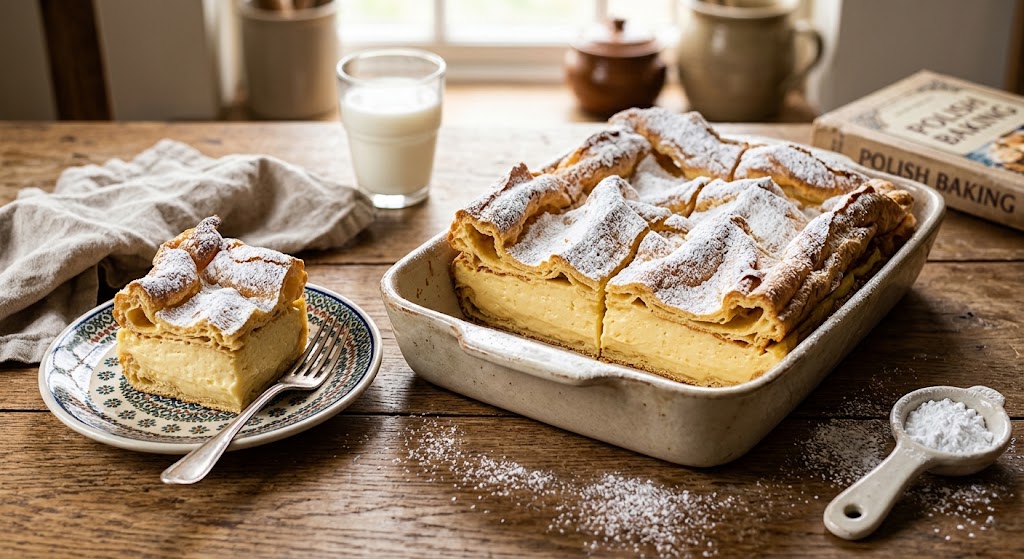
Karpatka is one of Poland’s most cherished classic bakes. Named after the jagged, snow-dusted peaks of the Carpathian Mountains (Karpaty), this dessert is famous for its contrasting textures: two layers of golden, wavy choux pastry sandwiched around a thick, silky layer of vanilla pastry cream (budyniowy), finished with a generous dusting of icing sugar.
The History of Karpatka Unlike ancient Polish traditional bakes like Mazurek or Sernik, Karpatka is a relatively modern mid-20th-century creation.
Origins (1950s–1970s): The term karpatka first appeared in Polish culinary literature in the 1950s, though the cake gained widespread popularity across Polish homes and milk bars (bary mleczne) during the 1970s and 1980s.
The Name: The moniker stems directly from the visual effect created during baking. When choux paste is spread onto a large baking tray rather than piped into individual buns, it expands unevenly in the oven. This forms random, dramatic "peaks" and "valleys". When dusted with icing sugar, the cake mimics the snow-capped summits of the Carpathian mountain range spanning Southern Poland.
Cultural Place: Karpatka quickly became a staple birthday, weekend, and celebration cake because it relied on simple, affordable ingredients—flour, eggs, milk, sugar, and butter—that were accessible even during periods of food rationing in Communist-era Poland.
Prep
30m
Cook
35m
Rest
240m
Serves
Rating
—
Total time · 1h 5m
Ingredients
Kitchen HelpShopping list
500 ml whole milk
100 g caster sugar
1 tsp vanilla bean paste — (or 1 vanilla pod, split and scraped)
2 yolks large egg yolks
1 egg large whole egg
50 g cornflour — (or potato starch)
30 g plain flour
200 g unsalted butter — (softened to room temperature)
250 ml water
125 g unsalted butter — (cubed)
0.25 tsp fine salt
150 g plain flour — (sifted)
4 eggs large eggs — (at room temperature)
1 tsp baking powder
2 tbsp icing sugar — (for dusting)
Tools
- · heavy-bottomed saucepan
- · bowl
- · whisk
- · wooden spoon
- · baking tin
- · baking parchment paper
- · electric mixer
- · wire rack
Instructions
Step by step
- 1
Make the Custard Base: Pour 400 ml of the whole milk into a heavy-bottomed saucepan. Add the caster sugar and vanilla bean paste. Heat over medium until it just begins to simmer, stirring to dissolve the sugar. In a separate bowl, whisk together the remaining 100 ml of cold milk, egg yolks, whole egg, cornflour, and plain flour until smooth and lump-free. Slowly pour a thin stream of the hot milk into the egg mixture while whisking constantly. Pour the combined mixture back into the saucepan. Place over medium-low heat, whisking continuously as it comes to a boil. Allow it to bubble for while whisking until it thickens into a heavy pudding. Pour into a shallow dish, press cling film directly onto the surface, and leave to cool completely to room temperature.
- 2
Bake the Choux Pastry Layers: Preheat your oven to 200°C (180°C fan / Gas Mark 6). Line a 20×30 cm baking tin with baking parchment paper. In a saucepan, combine the water, cubed butter, and salt. Bring to a rolling boil until the butter is fully melted. Turn the heat off completely. Dump in all the sifted plain flour at once and stir vigorously with a wooden spoon until it forms a smooth ball that pulls away from the pan. Return to low heat for 1–, stirring continuously to cook out excess moisture. Transfer to a bowl and allow to cool for . Add the eggs one at a time, beating thoroughly after each addition until shiny and smooth. Whisk in the baking powder with the last egg. Spread half of the choux paste unevenly across the bottom of the prepared tin. Leave the peaks and mounds rough to mimic mountains! Bake for 25 to until deep golden brown and crisp. (Do not open the oven door for the first ). Cool completely on a wire rack, then repeat the process with the remaining dough for the second layer.
- 3
Make the Butter Cream: Ensure the softened butter and the cooled custard are at the exact same room temperature. Beat the 200g of softened butter with an electric mixer for 3– until pale and fluffy. Add the cooled custard one tablespoon at a time, beating continuously until silky, rich, and firm.
- 4
Assemble and Chill: Line your baking dish with fresh parchment paper. Place the flatter choux layer at the bottom. Spread the vanilla pastry cream evenly over the base. Gently press the second, peak-topped choux layer on top of the cream. Cover loosely and refrigerate for at least 3 to 4 hours (or overnight) to set the cream and soften the pastry slightly.
- 5
Serve: Right before serving, dust the top liberally with sifted icing sugar and slice into squares.
Show AI-drafted nutritional details on this recipe?
Rate this recipe
Shared notes
Cook's annotations
No notes yet.
Family legacy
Audio reminiscence
A short voice memory — Mum reading the recipe out, a grandparent sharing the story behind it, a tip whispered while cooking. Up to ~60 seconds.
No audio memory yet.
Complete the table
Smart wine & side pairings
Evolution timeline
How this recipe has changed
Edit on 2026-10-26
Edited 10/26/2026, 1:58:34 PM