Historical cookbook
Grand Dictionnaire de Cuisine: Dumas's Culinary Dictionary
Alexandre Dumas's posthumous 1873 dictionary of cookery, and the bouillabaisse we modernised from it.
The story behind the book
Le Grand Dictionnaire de Cuisine was published in Paris in 1873, three years after Alexandre Dumas died in December 1870. It was issued as a substantial reference work arranged alphabetically, in the manner of a dictionary, and it remains one of the best-known late works associated with a novelist more famous for adventure fiction. The format suited the subject. An entry could be a brief note on an ingredient or a longer piece mixing method, opinion and story, and a reader could open the book almost anywhere. Because it appeared after the author's death, it is usually regarded as a record of a lifelong interest in food.
Who wrote it
Alexandre Dumas was born in 1802 at Villers-Cotterêts and became one of the most widely read French writers of the nineteenth century. The Three Musketeers and The Count of Monte Cristo, both serialised in the 1840s, made his name, and he was also a prolific playwright and travel writer. Alongside this he had a reputation as an enthusiastic eater and a capable cook, and he enjoyed entertaining friends at table. He died in 1870 at Puys, near Dieppe. His culinary writing carries the same personality as his fiction: confident, sociable and happy to digress. That voice is a large part of why the dictionary is still read, rather than simply consulted.
What's inside
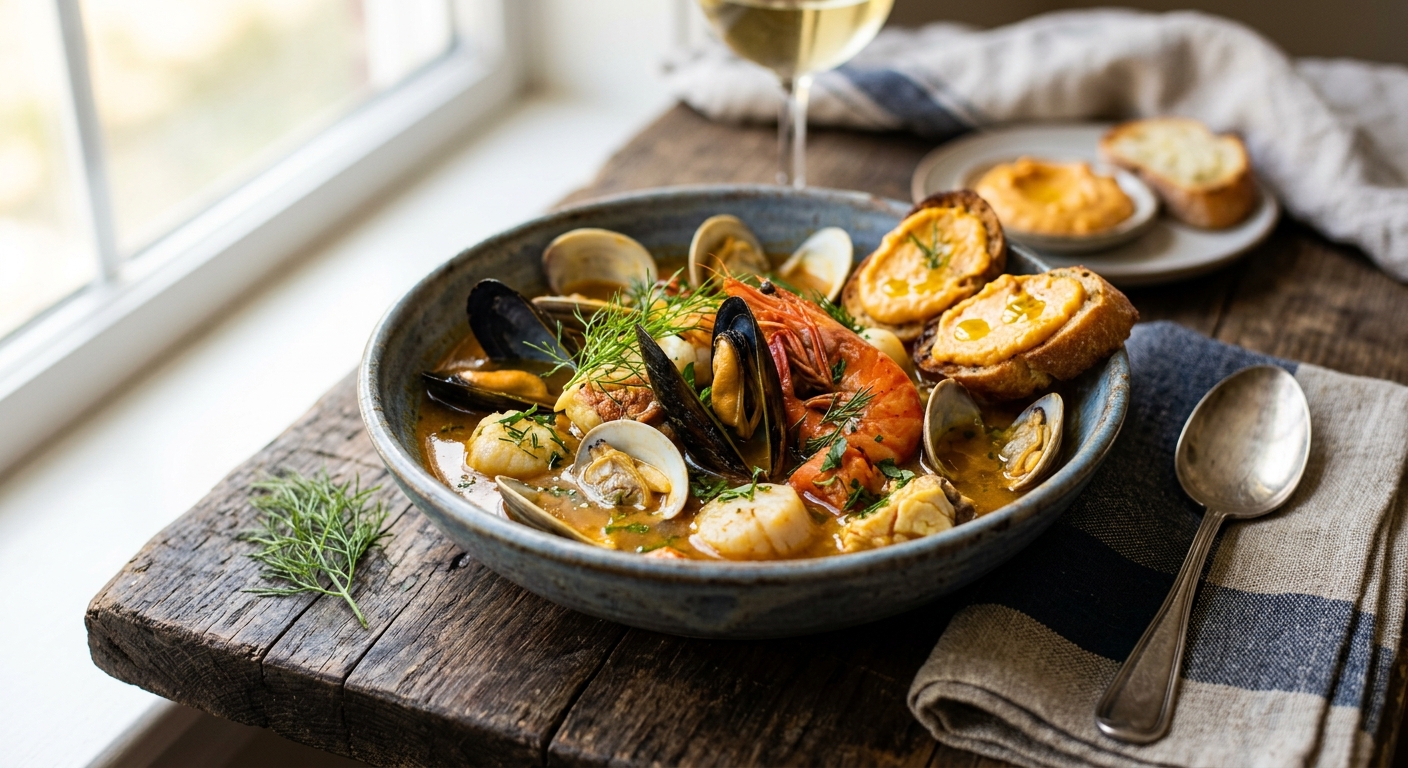
The dictionary covers ingredients, dishes and techniques in alphabetical order, with recipes sitting alongside anecdotes, historical remarks and the author's own opinions. Books of this period often give loose quantities and approximate timings, and assume a working knowledge of a nineteenth-century kitchen. Because the dictionary is so large, it is easiest to approach one entry at a time, and a single recipe is a good way in. Recipe Filer's Bouillabaisse (Dumas Style) takes the classic fish stew of Marseille and the Provençal coast and puts it into a form a modern cook can follow, with clear metric quantities and ingredients that can be bought in the UK. The aim is to keep the spirit of the dish rather than to reproduce the original wording. Anyone wanting more of the original in English can look for Dumas on Food, a selection from the dictionary translated by Alan and Jane Davidson and published in 1978.
Why it still matters
The Grand Dictionnaire de Cuisine matters because it shows how a nineteenth-century French writer thought about food: as something to be enjoyed, discussed and argued over, not only prepared. For cooks, it is a reminder that dishes now treated as fixed classics, bouillabaisse among them, can be cooked in many ways. For food historians, it is a source for the tastes and attitudes of the period, best read alongside other works and with some caution about its anecdotes. And for anyone who likes a good story with their supper, it offers a distinctive voice. Its alphabetical layout means that even a short visit can turn up something unexpected. Cooking one of its modernised recipes is a practical way of meeting that voice at the table.
Recipes from Grand Dictionnaire de Cuisine
Frequently asked questions
When was the Grand Dictionnaire de Cuisine published?
+
It was first published in Paris in 1873, after Alexandre Dumas had died in December 1870.
Who wrote the Grand Dictionnaire de Cuisine?
+
It is by Alexandre Dumas, the French author best known for The Three Musketeers and The Count of Monte Cristo.
Is the Grand Dictionnaire de Cuisine available in English?
+
Not in full, as far as we know, but Alan and Jane Davidson translated a selection, published in 1978 as Dumas on Food.