Historical cookbook
Le Cuisinier Royal et Bourgeois: Court Cookery of 1691
François Massialot's 1691 Paris cookbook for grand and well-off households alike.
The story behind the book
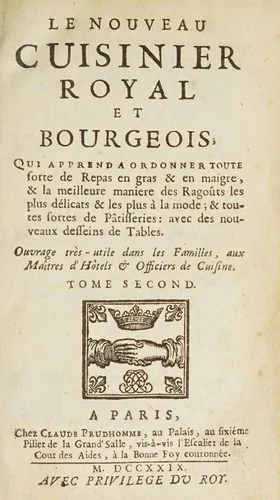
Le Cuisinier royal et bourgeois was published in Paris in 1691, during the reign of Louis XIV, when the French court set the standard for fashionable dining across much of Europe. The title signals its aim: it offered guidance for the tables of the great and for the households of well-off townspeople who wished to eat in a similar style. The book sold well enough to be reprinted and enlarged in later editions, and an English translation, The Court and Country Cook, followed in 1702. Its appearance is often seen as part of a wider shift in French cooking, away from the heavily spiced dishes of earlier centuries and towards sauces and ragouts built around stocks, butter and herbs.
Who wrote it
François Massialot was a working cook rather than a man of letters. He is recorded as having served in noble households, including that of Philippe, Duke of Orléans, the brother of Louis XIV, and his book reads like the product of that professional experience, concerned with how to plan, order and serve a meal. He is thought to have been born around 1660 and to have died in 1733. Beyond this, the details of his career are thinner than his reputation might suggest, so it is wiser to rely on the book itself than on later embellishment. His book was widely used and translated, which is one reason his name outlasts those of many contemporary cooks.
What's inside
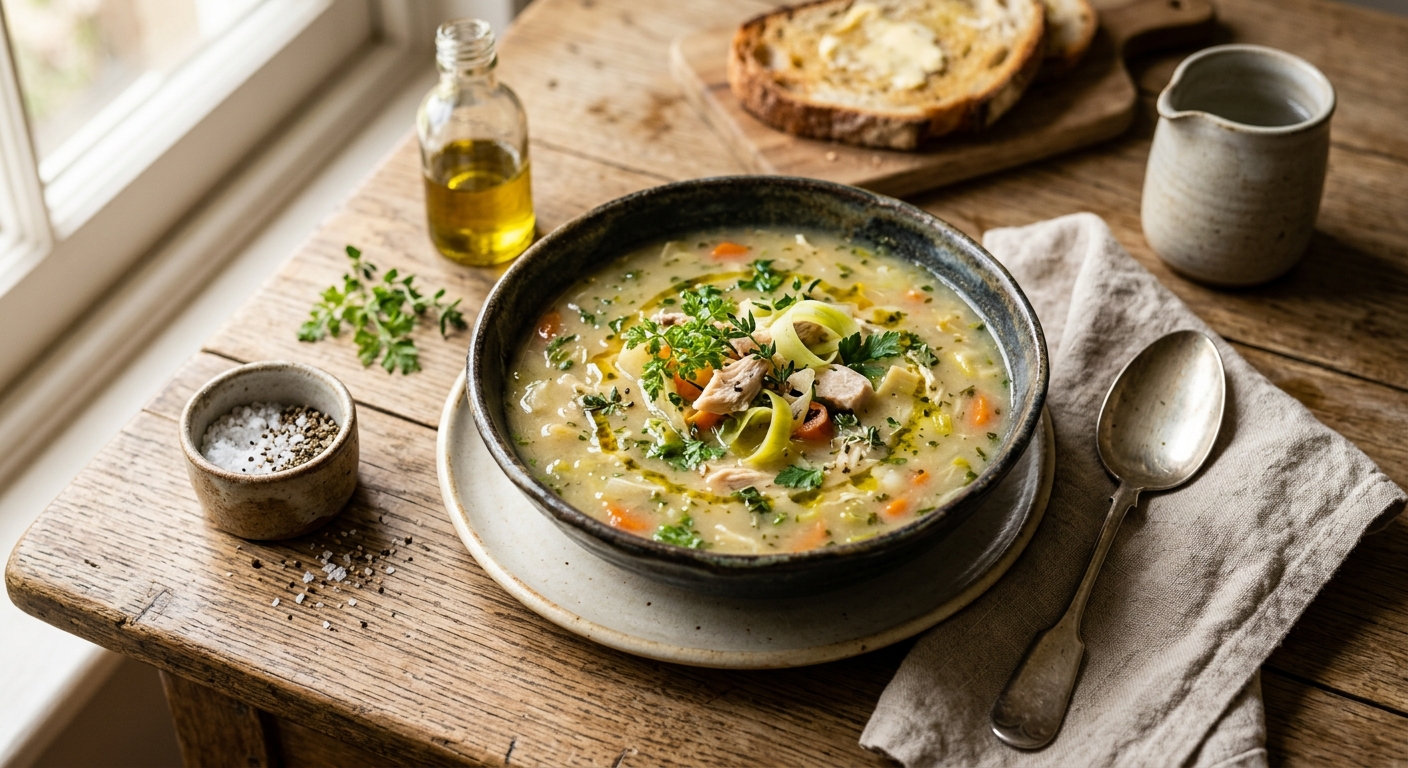
The book is organised around the practicalities of the table. It sets out how to arrange meals in successive services, with menus that vary by season and by occasion, and it gives recipes for soups, meats, fish, pies, sauces and ragouts to fill them. Later editions and companion volumes added confectionery, preserves and drinks. The instructions are brief by modern standards, assuming that the reader already knows the basics of the kitchen. Massialot is often cited for an early printed recipe for crème brûlée, which appears in the 1691 text. Recipe Filer has modernised two dishes from the book. Massialot's Omelette au Sucre is a sweetened omelette, and Massialot's Potage de Santé is a soup, both adapted for today's kitchens, ingredients and measurements.
Why it still matters
Massialot's book is valuable because it records how a professional cook of the 1690s thought about a meal as a whole: its order, its balance and its presentation. For anyone interested in how French cuisine developed, it is a primary source from the period before the better-known cookery writers of the eighteenth century. It also shows that many techniques still used today, such as building sauces on stock and seasoning with fresh herbs, were already established in the French kitchen. Modernising its recipes is not a matter of copying them exactly, since the original quantities and methods are often loose. Instead, the aim is to keep the spirit of the dish while giving a reliable method a home cook can follow. Reading the recipes beside the original text gives a clear sense of how much has changed in the kitchen, and how much has not.
Recipes from Le Cuisinier Royal et Bourgeois

Frequently asked questions
Who wrote Le Cuisinier royal et bourgeois?
+
It was written by François Massialot, a French professional cook who worked in noble households, including that of Philippe, Duke of Orléans.
When was Le Cuisinier royal et bourgeois first published?
+
It was first published in Paris in 1691, during the reign of Louis XIV.
Was Le Cuisinier royal et bourgeois translated into English?
+
Yes, an English translation titled The Court and Country Cook appeared in 1702.