Historical cookbook
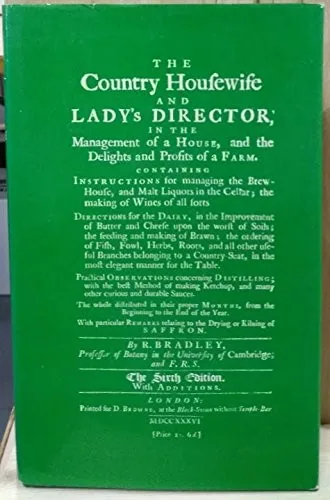
The Country Housewife and Lady's Director: Georgian Household Guide
Richard Bradley's household and farm manual, in the 1736 edition used for Recipe Filer's Icy Cream.
The story behind the book
The Country Housewife and Lady's Director in the Management of a House, and the Delights and Profits of a Farm is an English household manual of the early eighteenth century. Its title points to two readers: the woman running a country household and the lady who directs its servants. Richard Bradley died in 1732, so the 1736 edition that Recipe Filer cites was published after his death. The book belongs to a long English tradition of practical guides that treated cookery as one part of running a household, alongside brewing, dairying, keeping animals, growing vegetables and preserving food for the months when fresh supplies ran short. Among the recipes we have modernised from it is Richard Bradley's Icy Cream, a frozen cream dish that shows cold desserts reaching English cookery books in this period.
Who wrote it
Richard Bradley was born around 1688 and died in 1732. He was a botanist and a writer on gardening and farming rather than a professional cook. He was elected a Fellow of the Royal Society in 1712 and became the first Professor of Botany at Cambridge in 1724. His other titles include New Improvements of Planting and Gardening, from 1717, and A Philosophical Account of the Works of Nature, from 1721. He wrote prolifically for a general readership, and helped to popularise horticultural and agricultural knowledge. That background shapes the Country Housewife, which treats the kitchen as part of a productive estate, where good food depends on how well the garden, dairy and farmyard are managed.
What's inside
The book mixes recipes, seasonal advice and household instruction, covering the kitchen, the dairy, the garden and the farm as parts of one working household. Recipes of this period are written as running prose, without ingredient lists or precise measures, and they assume the cook already knows the basic techniques. That is why modernising them takes interpretation: quantities, temperatures and timings have to be worked out and tested. Richard Bradley's Icy Cream is an example. Ice cream was a luxury in early Georgian England, needing ice, which wealthier estates stored in ice houses, so a frozen dish in a book for country households is a notable inclusion.
Why it still matters
The Country Housewife is useful to food historians because it shows how a botanist and agricultural writer thought about eating: as the end of a chain that began with soil, seasons and animals. For modern cooks, its recipes are a window into early Georgian tastes, including the appetite for sweet, cool and elegant dishes. Because the originals leave so much unstated, each modernised recipe is an interpretation rather than an exact reconstruction. We try to keep what Bradley's text does say while making the method workable in a modern kitchen. Richard Bradley's Icy Cream is a good place to begin: simple in outline, rooted in a period when frozen desserts were still a novelty for many English households, and rewarding for anyone curious about how ice cream was made in early Georgian kitchens.
Recipes from The Country Housewife and Lady's Director

Frequently asked questions
Who wrote The Country Housewife and Lady's Director?
+
It was written by Richard Bradley, a botanist and writer on gardening and farming who became Professor of Botany at Cambridge in 1724. He died in 1732.
Which edition of The Country Housewife does Recipe Filer use?
+
Recipe Filer cites the 1736 edition. Bradley died in 1732, so that edition appeared after his death.
Which recipe from The Country Housewife has Recipe Filer modernised?
+
We have modernised Richard Bradley's Icy Cream, a frozen cream dish. The original gives no precise measures, so our version is an interpretation adapted for a modern kitchen.