Historical cookbook
The English and Australian Cookery Book: A Colonial Classic
Edward Abbott's 1864 cookbook paired English household cooking with the realities of colonial Australian life.
The story behind the book
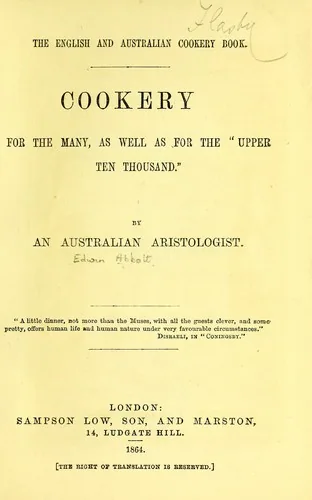
The English and Australian Cookery Book was published in 1864, and its full title promises cookery 'for the many, as well as for the upper ten thousand'. That phrase captures its aim: a single volume useful to a modest household and a grand table alike. At the time, cooks in the Australian colonies mostly worked from British manuals written for British kitchens, with British ingredients and seasons in mind. Abbott's book spoke to colonial cooks directly, and it is widely described as the first Australian cookery book by an Australian-born author. That makes it a valuable record of how settlers adapted the English repertoire to local meat, produce and circumstances.
Who wrote it
Edward Abbott (1801–1869) was Australian-born, and the book was issued under the description of an 'Australian Aristocrat' rather than naming him outright. He wrote as a colonist and householder rather than as a trained chef, and the book's voice is practical and plain. Its recipes are brief and assume a cook with some experience, which is typical of the period. Readers approaching him as a cook should remember that he was a colonial figure writing for other colonists, not a professional with a restaurant or hotel kitchen behind him. Where biographical details are uncertain, it is better to let the book speak for itself than to invent a life around it.
What's inside
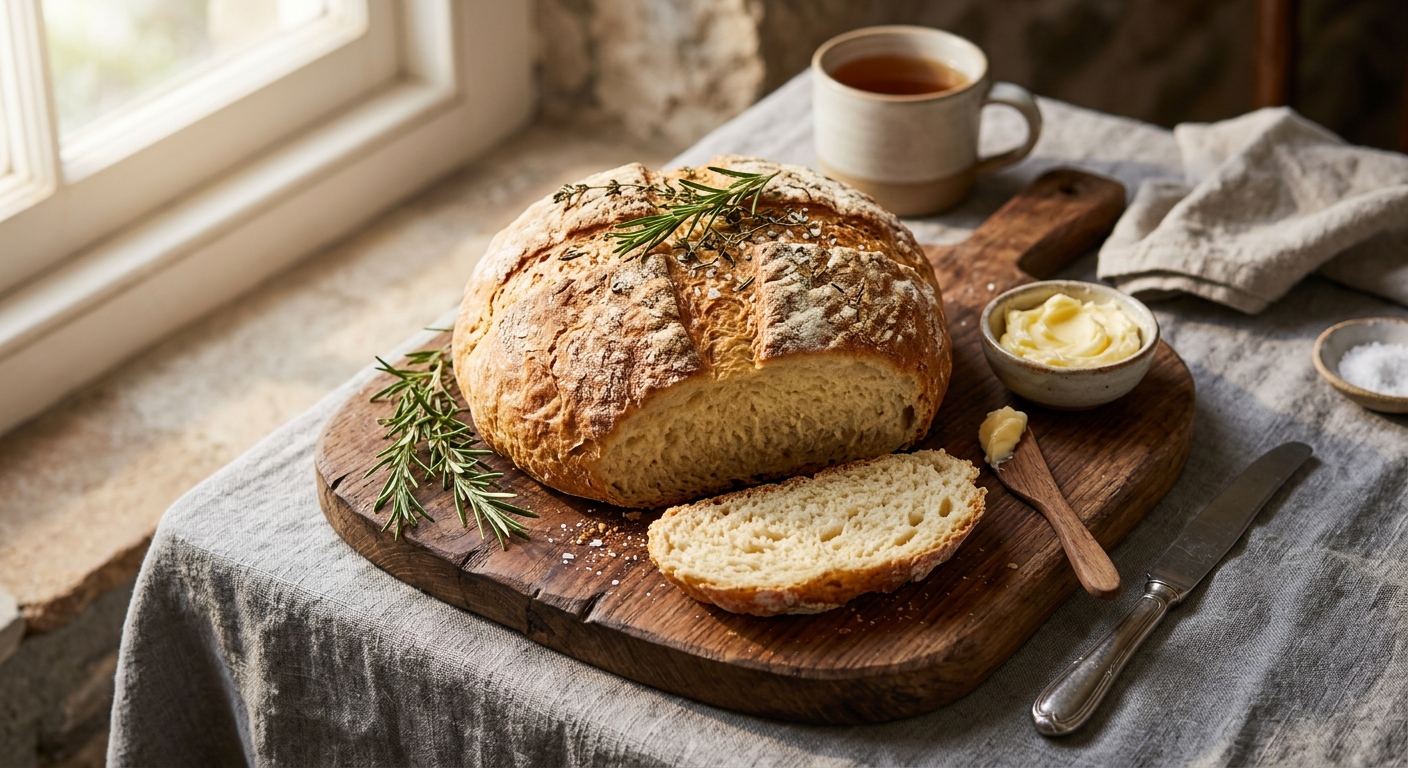
Like most Victorian cookery books, it covers the familiar ground of meat, puddings and everyday household dishes, with English recipes sitting beside methods suited to colonial conditions. Among the recipes Recipe Filer has modernised is damper, the Australian bushman's bread. Damper is a simple loaf of flour, water and salt, traditionally mixed on the spot and baked in the embers of a campfire by stockmen and travellers who had no oven and no yeast to hand. Abbott's version belongs to that tradition of bush cooking. Our modernised recipe keeps the spirit of it while giving clear quantities, oven temperatures and timings, so that it can be made in a home kitchen as easily as over a fire.
Why it still matters
The book matters because it shows Australian food in the making. Reading it alongside later colonial and twentieth-century cookery writing helps trace how a British culinary inheritance gradually took on local character. It is also a reminder that recipes of the period were written for cooks who knew the basics and left out a great deal: oven temperatures, precise weights and timings are often absent, which is why modernising them takes care and some testing. Damper is a good example. It is a few ingredients and a little technique, yet it is one of the best-known foods associated with the Australian bush, and finding it in a book of 1864 connects today's cook with a long practice. For anyone interested in food history, in colonial Australia or simply in honest, unfussy baking, Abbott's book remains a useful and readable starting point.
Recipes from The English and Australian Cookery Book
Frequently asked questions
Who wrote The English and Australian Cookery Book?
+
The book was written by Edward Abbott (1801–1869), an Australian-born author, and was issued under the description of an 'Australian Aristocrat'.
When was The English and Australian Cookery Book published?
+
It was first published in 1864, and it is widely regarded as the first cookery book by an Australian-born author.
What is damper in Abbott's cookery book?
+
Damper is the Australian bushman's bread, a simple loaf of flour, water and salt traditionally baked in campfire embers. Recipe Filer has modernised it for a home oven.